In the data-driven retail world of today, it’s no longer enough to know how much you’ve sold; ultimately, success depends on why customers buy, when they enter your store and turn to make purchases, and what influences their purchasing decisions. As e-commerce has always been able to harness the power of analytics, physical stores are finally being introduced to it, all thanks to one game changing invention: The footfall counter.
Now, when correlated with data from Retail Analytics Software, the smart device is changing how brands approach performance metrics, layout optimization and customer experience. In this post, we’re going to look deeper into how footfall counters transcend sales figures and work to facilitate intelligent retail decisions.
Introduction: Changing the Conversation From Selling to Insights
Sales data has long been the primary measure of retail success. But sales only tell part of the tale. Two stores may have the same amount of revenue, but one might be getting many more visitors and converting fewer — an indication of untapped potential.
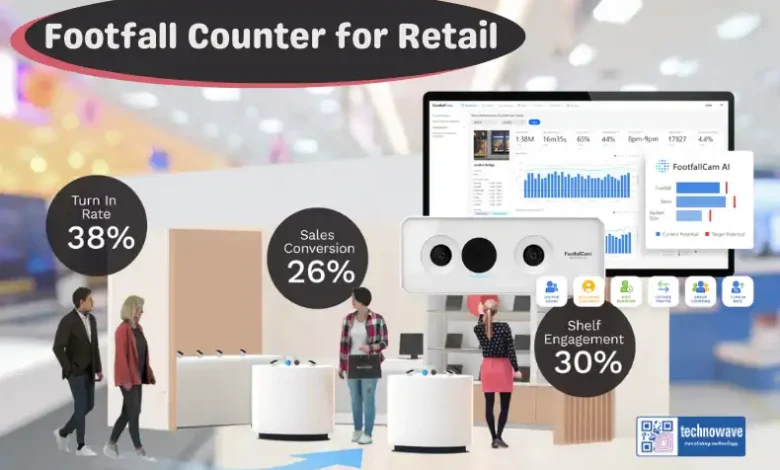
Now enters the footfall counter — a high-tech device that tallies the number of people who walk into a store and how they move through it (as well as when traffic peaks). When this information is combined with sales, inventory and marketing statistics in real time via Retail Analytics Software, retailers can finally see the end-to-end view of performance needed to take action.
What is a Footfall Counter – And How Does It Work?
A footfall counter may be either a device or a system programmed to monitor the number of individuals moving into and out of a specific place in real-time. Powered by infrared probes, 3D sensors, Wi-Fi tracking or AI-powered video analytics (to name just a few innovations), counters deliver precise live head counts.
Going beyond mere headcounts, the most sophisticated footfall counters can differentiate between staff and customers, monitor dwell time and even recognize repeat visitors — granting insights that go far beyond traffic counting.
Why Retail Analytics Providers Trust Footfall Counters
The integration of footfall counters with Retail Analytics Software has changed the way brick-and-mortar stores strategize. Here’s how these companies are using footfall data to facilitate smarter, better-informed business decisions:
Measuring True Store Performance
Unfortunately, sales figures alone do not tell us how well the store is at converting its guests to customers. With footfall counter data on hand, Retail Analytics Software are able to work out the conversion rate — i.e., sales per total visitors.
The measure enables retailers to see if high traffic equals revenue or if there’s a delta that they need to address with better merchandising, pricing or customer engagement.
Understanding Customer Behavior and Flow
Footfall data aids in visualizing how customers move around a store. Traffic pattern mapping companies focus on identifying where most customers are engaging, and which sections are being completely ignored.
Brands can use this knowledge to their benefit by strategically placing the more valuable items in high traffic areas, or revamping floor plans to be more accessible — both of which boost engagement and drive potential sales uplift.
Optimizing Staff Scheduling
WORKFORCE MANAGEMENT One of the most useful applications for a footfall counter would be workforce management. Retailers are able to monitor the patterns of visitors, both on an hourly and daily basis, to better staff their store.
For instance, if a store has peak customer traffic between 5 p.m. and 8 p.m., Retail Analytics Software can suggest adding staff during those times to improve service without being overstaffed when the foot traffic ebbs.
Evaluating Marketing Campaigns
A good marketing campaign not only increases sales — it drives customers in to the store. Retail Analytics Software can calculate the real impact of a campaign when comparing data annually on footfall before, during and after a store campaign.
If foot traffic goes up but sales stay the same, it could tell you that campaign brought in awareness instead of conversions — and arm you with data to tweak future promotions.
Enhancing Store Layout and Experience
Fearon Banks Customer experience is the foundation of contemporary retail. From footfall counter data, large analytics companies can even determine any congestion points in your store, cold zones and dwell times.
By altering displays, or repositioning signage according to these findings, brands can create a store experience that is more intuitive, inviting and as a result more pleasant for shoppers – directly improving overall experiences.
Supporting Inventory and Demand Forecasting
And knowing the real trends in footfall can help plan better inventory. Or if there are traffic surges on weekends, holidays or other seasonal events, merchants can prep for higher volumes of high-demand products.
Retail Analytics Software leverage these insights to match inventory levels to visitor patterns, reducing out-of-stocks and avoiding overstock.
Pros of Implementing Footfall Counters in Retail
When used right, footfall counters can provide value beyond simple analytics:
Data driven decision making: Go from guesswork to evidence based strategies.
Increased operational efficiency: Real-time insights let you staff better, stock efficiently, and market intelligently.
Increased engagement with customers: By learning how, when and where people are shopping.
Improved ROI tracking: Track the performance of each campaign or in-store initiative.
Competitive advantage: Lead other stores by utilising cutting edge in-store analytics.
And through Retail Analytics Software, small and mid-sized brands can realize these benefits – sometimes without having to invest in large, complicated technology stacks.
The Future of Retail Analytics: Intelligent, Predictive Insights
As the technology develops, foot-traffic counters are growing more intelligent and marrying up with other systems. Newer iterations will be capable of more than just tracking — they’ll predict trends, such as when visitors are most likely to come and how external forces (like the weather or nearby events) can affect foot traffic.
Retail analytics firms are already using this data in combination with ML to deliver predictive insights. The ability to get noticed about potential low performing days a few days ahead of time or real-time recommendations on how you should be advertising during rush times, these are the future of smart retail decisions.
Conclusion
In today’s competitive retail market, sales data alone is not enough. To stay ahead, brands will need to know every aspect of customer behavior — from the moment they walk in their doors to how they interact within the store.
When combined with the insights of Retail Analytics Software, a footfall counter turns this understanding up a notch into actionable intelligence. It allows retailers to streamline processes and enhance customer experience, and helps them to use data for informed decisions that lead towards long-term success.
Simply put, foot traffic counters aren’t just optional — but necessary in helping every consumer-facing company that prides itself on being particularly forward-thinking move beyond sales and into smarter success.
FAQs
1. What is a Footfall Counter, and Its Relevance to Retailers?
A counting system is used to count the number of people entering or leaving a store. It enables retailers to understand how visitors are circulating, perform and make better decisions for customer experience and store productivity.
2. What do Retail Analytics Software do with footfall data?
Retail Analytics Software combine footfall numbers with sales, marketing and inventory performance to enable retailers to comprehend conversion rates, better layout stores, and predict demand more precisely.
3. Can using a footfall counter help sales?
Yes, indirectly. In contrast to a footfall counter selling does not, it is the crucial link in understanding how customers are behaving, engaging with and presenting your store to improve layout and marketing – which all help to sell more.
4. Can footfall counters work for small retailers?
Absolutely. Today’s footfall counters are also inexpensive, and can be easily implemented in small, boutique stores all the way to huge retail chains.
5. What are contemporary footfall counters technologies?
Modern footfall counters utilise infrared sensors, video analytics using AI, thermal imaging, and Wi-Fi tracking to give accurate visitor data in real-time.